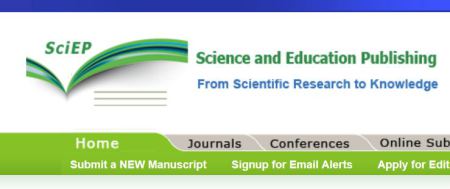
A brand-new open-access publisher has just appeared: Science and Education Publishing (SciEP). The publisher is launching with 85 new journals, the second large launch I’ve seen in a single week (OA Publishing London recently launched with 138 brand new journals).
This practice of starting a publisher with an excessive number of journals is called a “fleet startup.”
One interesting thing about SciEP is that the company does not reveal where it is from. Their “Contact us” page does not give any hint of a location. The location element of their domain-name registration is covered by a proxy. [Update Nov. 29, 2012: The contact us page now lists this address: 10 Cheswold Blvd., #1D, Newark, De, 19713, United States, which is a small apartment].
Predatory publishers often hide their true location when they think it will be a turnoff to potential authors.
A “call for papers” spam email the company is sending out says “Science and Education Publishing, USA,” indicating — probably falsely — that the publisher is U.S.-based.
I looked at the publisher’s inept Facebook page, which is set up as a person (rather than an organization) under the name Giovanni Sciepub. Could it be from Italy?

The spam email is signed “David Rain,” but this is a common name, and I cannot find anyone in the scholarly publishing industry with that name. A Google Scholar search on the name yields no usable clues. It’s probably a contrived name.
The email indicates that they are now accepting submissions, even though none of its journals has an editorial board yet — the editorial board pages are all blank. Submissions are free through the end of 2012 and they plan to release their first journal issues in February, 2013.
Because of its lack of transparency and probably use of a fake name, I strongly recommend against serving on any of this publisher’s editorial boards and against submitting a manuscript to any of its journals.
Hat tip: Lynne Fox, Charlie Greenberg
Appendix: List of journals published by Science and Education Publishing:
- American Journal of Public Health Research
- American Journal of Medical Sciences and Medicine
- American Journal of Pharmacological Sciences
- American Journal of Medicine Studies
- American Journal of Food and Nutrition
- American Journal of Epidemiology and Infectious Disease
- American Journal of Medical and Biological Research
- American Journal of Clinical Medicine Research
- American Journal of Nursing Research
- American Journal of Hypertension Research
- American Journal of Cardiovascular Disease Research
- American Journal of Sports Science and Medicine
- American Journal of Cancer Prevention
- American Journal of Infectious Diseases and Microbiology
- American Journal of Biomedical Research
- American Journal of Microbiological Research
- American Journal of Zoological Research
- American Journal of Applied Psychology
- American Journal of Educational Research
- American Journal of Rural Development
- American Journal of Modeling and Optimization
- American Journal of Numerical Analysis
- American Journal of Applied Mathematics and Statistics
- Applied Mathematics and Physics
- American Journal of Mathematical Analysis
- American Journal of Mechanical Engineering
- American Journal of Industrial Engineering
- American Journal of Civil Engineering and Architecture
- American Journal of Electrical and Electronic Engineering
- Automatic Control and Information Sciences
- American Journal of Energy Research
- American Journal of Sensor Technology
- American Journal of Vehicle Design
- American Journal of Materials Science and Engineering
- American Journal of Nanomaterials
- American Journal of Materials Engineering and Technology
- American Journal of Mining and Metallurgy
- American Journal of Information Systems
- American Journal of Software Engineering
- American Journal of Systems and Software
- Applied Ecology and Environmental Sciences
- American Journal of Environmental Protection
- American Journal of Marine Science
- American Journal of Water Resources
- American Journal of Food Science and Technology
- Biomedicine and Biotechnology
- Biomedical Science and Engineering
- Chemical Engineering and Science
- International Journal of Clinical Nutrition
- International Journal of Physics
- Information Security and Computer Fraud
- Journal of Surgery
- Journal of Preventive Medicine
- Journal of Nutrition and Health
- Journal of Cancer Research and Treatment
- Journal of Biomedical Engineering and Technology
- Journal of Mathematical Sciences and Applications
- Journal of Ocean Research
- Journal of Optoelectronics Engineering
- Journal of Embedded Systems
- Journal of Automation and Control
- Journal of Instrumentation Technology
- Journal of Materials Physics and Chemistry
- Journal of Business and Management Sciences
- Journal of Finance and Accounting
- Journal of Finance and Economics
- Journal of Computer Sciences and Applications
- Journal of Computer Networks
- Journal of Geosciences and Geomatics
- Journal of Atmospheric Pollution
- Journal of Aquatic Science
- Journal of Food and Nutrition Research
- Journal of Food Security
- Materials Science and Metallurgy Engineering
- Nanoscience and Nanotechnology Research
- Physics and Materials Chemistry
- Research in Psychology and Behavioral Sciences
- Renewable and Sustainable Energy
- Research in Plant Sciences
- World Journal Control Science and Engineering
- Wireless and Mobile Technologies
- World Journal of Analytical Chemistry
- World Journal of Organic Chemistry
- World Journal of Environmental Engineering
- World Journal of Agricultural Research


You do not make good research before commenting. In the contact us page, it is mentioned “10 Cheswold Blvd., #1D, Newark, De, 19713, United States”. In Google map, this address is available.
The open access journals charge publication fee. To receive fee, the bank account is needed for any publisher. The bank will open an account only after address verification physically. Moreover, when a customer of a bank receives money from other countries, there are certain Forex procedures to be followed by banks in all countries. The publisher can’t simply cheat banks. Do you think the bank will not make address verification? If so, tell me which bank so that we can inform the relevant Government.
Look at the below webpage”
http://departments.columbian.gwu.edu/geography/people/121
David Rain is Director, Environmental Studies Program; Associate Professor Geography and International Affairs
I do not know whether this David Rain is associated with this new publisher. But you can’t say that David Rain is a fake name.
You are misleading the readers of your blog. You do not allow any new publisher to grow. I think your judgments are absolutely biased.
The moment a new publisher starts the business like this new publisher, you immediately stamp as predatory even before publishing single article. If every author believes you, no one will submit article to these new publishers. You try to kill all new publishers at infancy stage of their business.
If somebody says against your comment, you immediately say in your blog “you go and publish with this new publisher and they also will be happy to publish your work”. This is not correct way for you to defend. At the same time, I am not recommending everyone this publisher. Allow the publisher to publish at least some articles. Assess the publisher based on the quality of articles. You can download some of the articles and send the articles to some academicians of the relevant field and publish those experts comments. When you evaluate the articles, there must be transparency. If you simply say that it was evaluated by some (undisclosed) experts, then how can you say those publishers are not transparent in their peer review or in their editorial operations?
When I visited some of the publishers listed on your so-called predatory publishers list and their articles, the quality of articles of some publishers are really good. Ultimately, if the publisher is predatory, the quality of articles will be poor. So one must stamp a publisher purely based on quality of articles.
You always judge based on some spam emails. Hindawi used and still uses spam. Versita Open still uses spam. Why these two have been removed in your list recently?
There are several very low quality articles in Hindawi (I checked analytical chemistry area articles). You ask some analytical chemistry researchers whether any analytical chemistry article of Hindawi can ever get published in Analytical Chemistry journal of ACS.
What happens at BMC Head and Neck Oncology journal? Why the journal has been closed In June 2012? After June 2012, did you ever contact BMC to know the reason in the past 5 months? Is it not part of your research? Have they not established a good system even though BMC is in open access publishing business for last 12 years? Are their policies so week? Can any single / multiple editors of BMC tamper with the corporate policy / business processes of BMC?
When the organisation Dell was started, do you know what the investment size was and how Dell was competing with giants like IBM? Do you know where Dell assembled his initial computers? I know that all cannot become Michael Dell. But we should allow entrepreneurs to develop and encourage good business competition. We should not kill small and new businesses. We should guide them in a more constructive way to do the business in more ethical way. This will be our true contribution if we are really willing to encourage open access.
That address did not appear on the webpage when I researched my blog post. In any event, it’s a small apartment. Do you really think that 85 journals can be published successfully out of an apartment? You also didn’t understand what I said by fake name. It is not the name of the person who actually wrote the spam email — it’s a fake name for that person. Yes, of course, there will be really people with that name, but they have nothing to do with this corrupt operation.
What publisher are you associated with?
I judge publishers, not articles. It’s not uncommon for very fine articles to appear in predatory journals. This occurs because the predatory publishers trick honest researchers into submitting their work so they can get the author fee.
I think you are in a state of denial. There are many corrupt publishers appearing every day. The word is out — you can make easy money bu starting up a scholarly publishing website. This is another example, and a particularly malevolent one.
I don’t understand your questions about BMC; they make no sense.
Definitely I am not in a denial mode. I want to be more constructive for your blog.
Even if it is an apartment, 85 journals can be managed if all the editorial operations are handled online by each editors-in-chief. Editor-in-Chiefs can assign manuscripts for peer review to various reviewers online itself from each editors-in-chief’s university or house. The copyediting and proofreading can be outsourced completely. Most of the operations of Dell even today are outsourced and they do not have much in-house operations though the final product is physical computer. When you place an order with Dell, all the suppliers are notified on the new order and the assembling and shipping processes start. When a computer can be supplied by Dell with more of outsourcing, why can’t an electronic product “scholarly article” be published by outsourcing? With a well managed software, one can definitely manage 85 journals even within an apartment.
If the address did not appear when you visited the webpage, why didn’t you attempt to send an email to the publisher? There are email ids given there. If I maintain a blog like you for the public, I would be more careful before publishing my comments and I would have asked the publisher for the address.
You are just commenting on website links, title of the journal, images used on the website, country of editorial board members etc. You make some fun out of them. The whole problem is that you judge the publisher without judging the articles. A fake publisher cannot attract good articles continuously. So if frequent assessment on quality of articles is done, I am sure that a fake publisher can be caught. A subject expert can judge whether peer review is done or not by reading the published article. Why don’t you ask for peer review reports from the publisher if you have doubt on the peer review for a specific article?
A publisher is predatory only if the articles are published without peer review just for the sake of author fee. This is what our major concern. If we can ensure / force the publisher to do the peer review, we can force the publisher to be ethical. The unethical publishers will not emerge. You can suggest new ways / policy / system to ensure peer review process in place for open access articles.
By just keep on listing new publishers on your list every day, I am sure that the list will be keep growing in near future also. But it will not solve the problem associated with the open access publishing in the peer review process.
I think we should spend our energy, expertise, knowledge, intelligence, our scholarly network to discuss (brainstorm) to come out with ideas for ensuring peer review for open access articles.
For example, can the peer review reports be made available publicly (with or without referee names?) Should the peer review reports be made available upon written request (if so, written request by whom). Let us think in more progressing way.
In your list of predatory publishers, can you come out for how many publishers you found that they publish without peer review?
Well, I disagree with pretty much everything you said. Your criteria for determining predatory publishers is simplistic and naive. Are you associated with a particular publisher? If so, which one? If you’re happy with a publisher operating 85 journals out of a cheap apartment near Interstate-95, then that’s fine — it reveals a lot. Your comparisons to Dell are specious — it’s a completely different industry. And there are many small companies that start out with bad intentions too. Also, I did email the publisher but got no response, so stop making stuff up. I stand by my analysis of this company. I recommend against having any professional contact with them.
I agree with Daniel Corcos. We should think to solve the problem with OA scholarly publication.
Who are you? How would you solve the problem?
Shooting spam e-mails indiscriminately is no way a good beginning. I think it should be enough to brand an OA publisher ‘predatory’ on just one account – ‘throw the net and catch as much as you can’ approach. Journals are built, not merely started. I think, none is empowered to act against predatory OA journals, as of now. Now one can only spot them. These publishers should ensure constitution of a robust editorial board for each journal. For 85 journals, I think, a publisher needs to identify at least 85 scholars. Given the variety of journals in this case, I think SciEP should have a ‘spotless’ list of about 500 scholars in total who have genuinely agreed to be a part of the evaluation process. If SciEP has done it, well, it has begun well. Has SciEP done it? Also, inviting articles from this list of scholars and throguh their contacts would be a good beginning. Such articles may also attract citations and help the journal grow. Publishers provide only the administrative framework and they need academicians’ support to complete the system. In what Dr.Beall lists in this forum, I see neither. Am I right? I believe there is no need to sympathise with such publishers who fail to do initial preparatory work. I would also say these publishers, in a way, have no regard for either the concept of publishing or the philosophy of science.
Come on 85 Journals and they are planning for conference also, which will cost you more than 1500$ for 2 days. If that does not make think twice or 1000 time before defending them, I have no idea what would
Thank you for the great post. I also got an email from “David Rain” and started browsing their website. Some things just didn’t look right. None of their publications had ISSNs, no editorial boards, no names of editors, editor in chiefs… This is definitely some smart scammer trying to make some extra bucks. There should be more expose like yours, so people don’t actually fall victim to these criminals.
I just want to share my experience of web publication: in 2012, my research article was published in Journal of Advances in Developmental Research’ , recently one of the interviewer brought to my notice that this journal is no more publishing, the journal site appeared to be closed and I was shocked and felt very awkward. Can anybody tell me was that a fake publication? Shall I re-publish my valuable research?
Yep, got the spam e-mail from them too. Funny how they can’t do even this right. They addressed it to me but sent it to a colleague of mine.
You want to know how to build a journal? I suggest checking eLife, published by HHMI. They start building in almost two years before the first issues. So, yes, if you start by dumping out 85 journals with no editorial boards and want me to believe that you are a real “new” publisher, then I have a nice beach in Arizona especially for you :)
Thanks for the valuable info. Received their spam email today and immediately tried to look up the publisher, which led me to this page.
Thank you for doing the legwork. I got the spam today, and the sciepub site is giving a 502 error.