
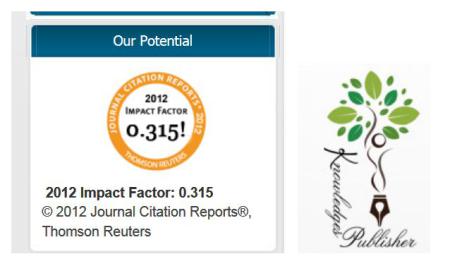
If you want a really good example of a predatory publisher, have a look at KnowledgesPublisher. This brand-new publisher uses lies and deception to make itself look legitimate. The journal has a large logo on the left side of the page that says, “2012 Impact Factor 0.315!” The problem is that the 2012 impact factors have not been published yet and won’t be until summer.
At the bottom of the page, the site has this statement, “Copyright © 2013 Elsevier Inc. All rights reserved.” This is deception; the journal is trying to associate itself with Elsevier. In fact there is no connection. Also, if you click on the “Journals” link at the top of the page, you’re brought a list of Elsevier journals on the Elsevier website.

It appears the site really only has a single journal, called Advanced Crop Science. The journal has a contrived editorial board that does not list affiliations, only name and field of expertise. The journal uses Yahoo.com email addresses: KnowledgesPublisher@yahoo.com and Editor@KnowledgesPublisher.com.
When I first began examining the website, it bore this address information: 350 Albert Street 14th Floor Ottawa, ON Phone: 416-934-5714 Fax: 1-800-565-3770. However, this information has since been removed from the website. The site’s “Contact us” page now only has a web form and gives no information.
The “previous issues” page indicates that the journal has published monthly since January, 2011, but there are no links to the content. I think the previous issues page is bogus and that the January, 2013 issue is the first and only issue. Looking at the “current issue,” one finds that you cannot access most of the supposed content. The articles listed in the table of contents are mostly bogus. The little content that is there is mostly plagiarized.
This is a very corrupt publisher. Avoid any contact or association with this publisher at all costs.



Have you contacted Elsevier for them to take further action?
No, but I think they follow my blog.
The problems in journals predation has reached newer heights. Anyways sending information to Elsevier is important…it is not necessary that they will follow the blog…it will
Dear Jeffry
I think the owner of this site has tried to do something similar to other people who tried to stole ArchiveDeScience identifications.
Until a few days ago, they had six victims who paid 150$ each and hope your efforts stop them at early stage. I know some one who has already sent email to ELSEVIER. They also abused University of Ottawa logos and tried to pretend they are affiliated with this university.
Thanks for introducing this blog at early stage.
Naser
Have a look at Quazzy – I just got spammed by them. Editor of Journal of Peoples and Culture is a chemistry prof in India. His name appears under “Editrial Borad Members”…
Thanks, I’ll have a look: http://quazzyjournals.org/index.htm
If you fake an impact factor for your journal, why not being a little bit more ambitious than 0.315? That´s like proudly announcing to be the fifth billion greatest lover in the world. Obviously the person in charge has no clue what a good impact factor is.
Yeah, I could crumple my manuscript into a ball of paper, throw it out my office window, and expect more people to read it.
The funny thing with this so called publisher is that their journal does not have any ISSN. As you can see, one does not need to even register a journal with ISSN portal to fool some people.
I recommend having a separate list for publishers like OMICS and this one. I think if publishers clearly try to put false statements like
fake Impact Factor,
false statement on being listed on ISI, Scopus, etc.,
false statement on having collaboration with well-known publishers,
publishing many plagiarized papers,
overcharging scholars’ credit cards more often,
keeping scholars’ papers hostage and keep calling them over and over to receive payment,
they are clearly criminals and scholars must avoid them.
Naser
Very interesting. I would like to ask Mr. Beall about cases when a predatory publisher have a real connection with a well-known publisher; like, f.e, when Atlantis Press co-publish journals with Taylor&Francis
http://www.tandfonline.com/toc/tnmp20/current
http://www.tandfonline.com/toc/tcis20/current
or can legitimly claim that some of its journals are indexed in Scopus
http://www.scimagojr.com/journalsearch.php?q=EuroJournals,%20Inc.&tip=pub
or even ISI WoK , as in the case of Baishideng’s World Journal of Gastroenterology (with a -real- 2.240 IF).
Can it harm a researcher’s academic reputation if hu publish with these publishers? I mean, what can be a more legitimate insurence for journal quality than reputable academic presses and ISI/Scopus inclusion?
The journal in the first link above ended its collaboration with T&F in 2008; the second appears to be a current collaboration as you indicate.
I don’t think being indexed in Scopus is really a valid measure of anything.
Regarding your final question, it depends. How will a P&T committee judge publications in these venues. It will likely differ depending on the committee.
Well, Scopus is perhaps controversial from this aspect, but they do have a (not-so-light) screening process. Even if we accept that inclusion in Scopus is not a measure of quality can we say the same about ISI? (i forgot the link to WJoG in my previous post; http://science.thomsonreuters.com/cgi-bin/jrnlst/jlresults.cgi?PC=D&mode=print&Page=18 ) Perhaps “predatory” designate a bad policy, but a predatory journal can also have a somewhat high impact and scientific merit. If researchers submit quality articles to predatory journals and these articles become cited and discussed in the scientific community, than the journal is seen as legit, regardless of its predatory policy.
I am not sure if I follow what hoicsi is saying
@hoicsi, wasn’t “World Journal of Gastroenterology” caught gaming JRC (self citation)? It is possible to cheat the citation.
true. but that was some 10 years ago. In 2008, WJoG was restored to JCR and received a new IF.
Schmuck: I’m 1.) saying that good articles will get recognized even if they appear in predatory journals, and the predator may benefit from that recognition 2.) wondering if the rigor of a journal selection process may be an assurence of the quality of the articles published in a given journal, REGARDLESS of the predatory or non-predatory nature of that very same journal.
hoicsi,
Good science will always find its way into good publication. Good science has to pass the critical review of our peers and we have to be able to address their concerns. Hopefully, in the future, somebody will be able to repeat and build on our results.
However, if you are looking for a quick payoff you will accept to send your hard earned science to somebody who does not give a rat whatever you are saying as long as you pay their fees. By definition, this is predatory practice on both the author and the publisher side.
Under privacy statement, you find the following “please contact KnowledgesPublisher at info@faratechdp.com.”
If you look for faratechdp.com it takes you to some news (I am not sure as I cannot read the language. Maybe somebody here speaks Persian (or excuse my ignorance, the language) to enlighten us
Schmucks: I have a question: Where do you position an article in an ISI-indexed journal on a good publication-bad publication scale? Among the full set of “publications”, I think that it would be closer to the “good” end of the scale. The good quality of an ISI journal is a “well-founded fiction” in the perception of the scientific community; not bounded to rigorous secondary investigatons. We trust in their journal selection process as much as investors trust in the ratings of credit rating agencies. I do not say that this is good, but this is the way it is. So there are some ISI journals that may follow a predatory business/article attraction policy. But ISI’s selection criterias does not include the investigation of “predatorines” or “non-predatoriness”. Can we call their system of selection flawed, based only on this fact?
They even stole the icons and hyperlinks (full-text available, etc.) from sciencedirect.com…
http://www.knowledgespublisher.com/2013January.aspx
cf. e.g. http://www.sciencedirect.com/science/journal/00014575
Hello! I hope you don’t mind but I decided to post your weblog: http://scholarlyoa.com/2013/02/05/corrupt-new-publisher-fakes-association-with-reed-elsevier/ to my on-line directory website. I used, “New Publisher Fakes Association with Reed Elsevier | Scholarly Open Access” as your weblog headline. I hope this is acceptable with you. However, if you’d like me to change the title or remove it completely, contact me at jewelleller@bigstring.
com. Thanks for your time.
can you evaluate this journal?
i think they fake people.
http://www.knowledgebasepublishers.org
Please see my list; this one is there.
I have identified the true original version of one of the fake papers in the journal “Advanced Crop Science”:
The article “RESPONSE OF MAIZE TO LIMING AND AMELIORATIVE PHOSPHORUS FERTILIZATION”
by I. Komljenović, M. Marković, Danijela Kondić, V. Kovačević,
in Advanced Crop Science, Volume 3, Number 3, pp 225-232
has been copied from the Croation open access journal “Poljoprivreda / Agriculture”, from volume 16(2):9-13, December 2010.
Here is the link to the original article:
http://www.pfos.hr/~poljo/?q=vol-16-2-2
Nice detective work!
come on, who can we trust? u really mean we avoid them? but they published our article! I’m really confused, send or not send?
[...] a look at the rest of his blog. It makes for fascinating reading, from how new publishers are copying established publishers websites, to how they charge authors for [...]
[...] Based on actual data and facts, Beall very accurately describes why a journal is bogus, suspicious and sometimes even at the boundary of illegality (I can’t believe how some journals try to fool authors into believing that they are associated to legitimate and well known publishers, such as Elseviver in this exaple). [...]